
A Sponsor’s Brief Is Only One Perspective: A Facilitator’s Guide to Pre-Workshop Discovery
A sponsor’s brief is an important starting point, but it is rarely the whole context a facilitator needs. Learn how to invite participants to share experiences before a workshop, synthesize those accounts carefully, and use what you learn to design a more grounded process.

A sponsor’s brief is an important starting point. It is rarely the whole context a facilitator needs in order to design a useful session.
Consider a familiar assignment: “Align the leadership team on a multi-year strategic roadmap.” The purpose may sound clear. But before the workshop begins, important questions remain:
- How do participants experience the situation in their day-to-day work?
- What recent events, decisions, relationships, or constraints are shaping how they approach the topic?
- What does the sponsor’s brief leave open, ambiguous, or unexamined?
- Where might participants bring different expectations, priorities, or concerns into the room?
- What would the facilitator need to understand before finalizing the agenda?
The sponsor has not necessarily overlooked these questions. They occupy one position in the situation, as does everyone else. But when an agenda is designed from a single account, it can miss conditions that will shape how the group encounters the work.
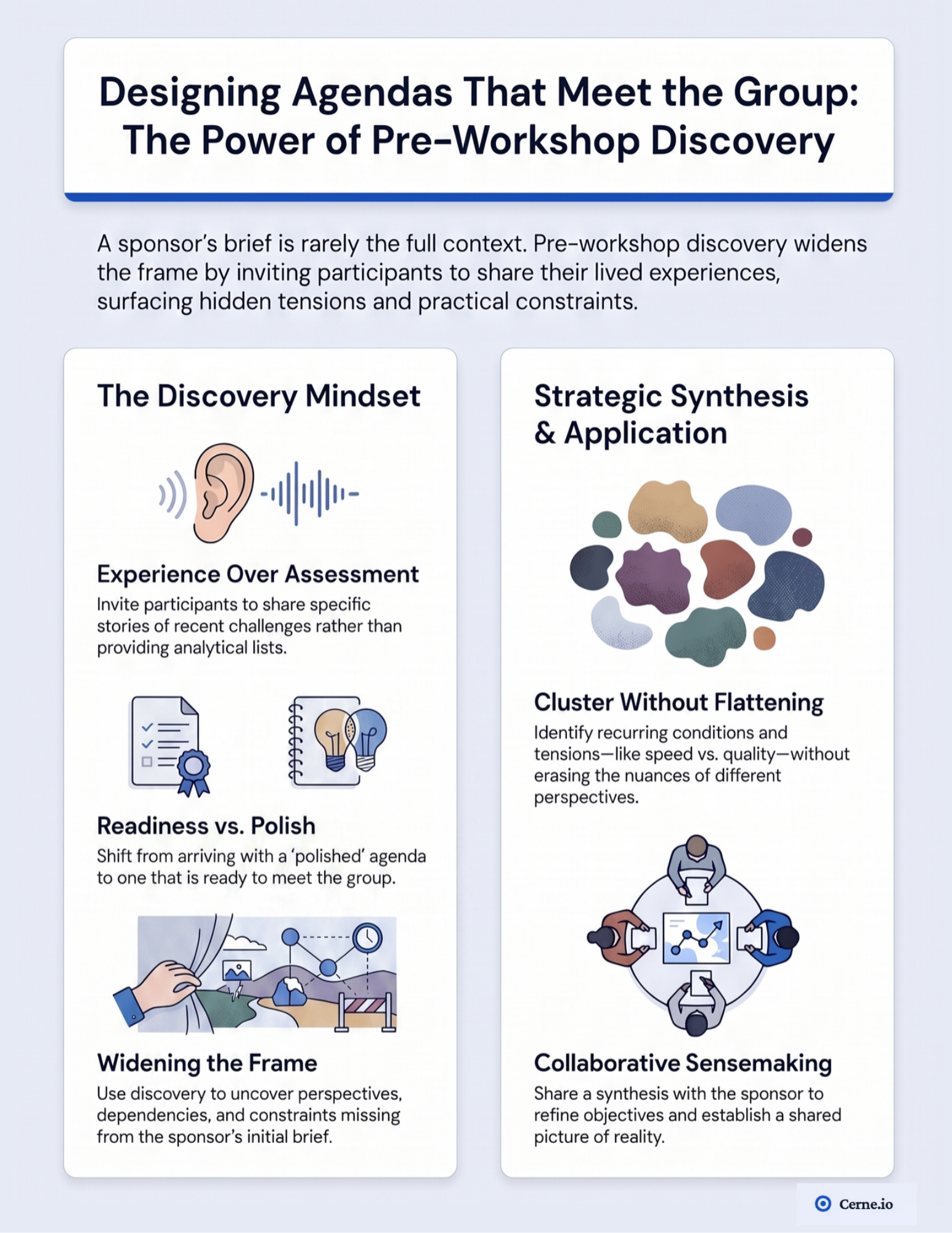
Pre-workshop discovery helps a facilitator widen the frame before the agenda hardens. Its purpose is not to produce a definitive diagnosis, expose a hidden organizational truth, or prove that the sponsor is wrong.
It is to invite participants to share experiences, notice perspectives and tensions that may require further inquiry, and identify questions that can inform a more responsible workshop design.
That is the difference between arriving with a polished agenda and arriving with an agenda that is ready to meet the group.
What pre-work discovery can do
A thoughtful pre-work process can help you:
- Understand how participants experience the work and its current conditions
- Notice differences in perspective across roles, teams, or locations
- Identify expectations, dependencies, practical constraints, and unresolved questions
- Learn about previous events that may affect how people enter the session
- Test whether the original workshop purpose is sufficiently clear and realistic
- Prepare a more useful conversation with the sponsor before the agenda is finalized
- Help participants see that the process has been designed with awareness of their situation
It cannot, by itself:
- Establish an objective or complete account of the organization
- Resolve a conflict that requires a different process
- Guarantee candor, trust, or psychological safety
- Substitute for direct conversations where the situation calls for them
- Turn a short written inquiry into a reliable diagnosis
- Remove the facilitator’s responsibility to interpret carefully and work ethically
The value of pre-work is not certainty. Its value is that it gives the facilitator a broader basis for deciding what to ask, what to leave open, and what the group may need to work on together.
Start with the situation
Before choosing questions or sending an inquiry, clarify what you are trying to understand.
A workshop about strategy, for example, may appear to require alignment. But the situation may also involve competing assumptions about priorities, unresolved dependencies, previous decisions that have not been digested, or practical constraints that people do not feel able to name in a large meeting.
Ask yourself:
- What does the sponsor believe this workshop needs to accomplish?
- What remains uncertain about the situation?
- Whose experience is currently missing from the brief?
- What might participants need in order to engage usefully?
- Are there power differences, conflicts, or sensitivities that make written pre-work inappropriate?
- What would change in the agenda if participants described the situation differently from the sponsor?
The goal is not to challenge the sponsor for its own sake. It is to avoid treating the first description of a situation as the only description that matters.
Choose a method that fits
A written inquiry can be useful, but it is not always the right method. The choice depends on the purpose of the session, the group’s history, time available, power dynamics, confidentiality requirements, and the type of input you need.
| Situation | A possible approach |
|---|---|
| A large group with limited preparation time | A short written inquiry with a small number of open prompts |
| A small group with significant tension or low trust | Confidential one-to-one conversations, often with the facilitator |
| A topic that needs shared interpretation early | A short group conversation before the main workshop |
| Strong hierarchy or fear of attribution | Reconsider access, confidentiality, and whether written collection is appropriate |
| A practical planning workshop | A concise pre-work inquiry focused on lived constraints, dependencies, priorities, and success conditions |
| A sponsor brief that is especially vague | A contracting conversation with the sponsor, followed by targeted stakeholder input |
Do not use a questionnaire simply because it is easy to distribute. The method should serve the inquiry.
A short written inquiry works well when you need broad early input and when participants can reasonably respond in their own time. Interviews may be more appropriate when nuance, trust, or sensitive context matters more than breadth. A group conversation may be the right first step when the central task is not collecting individual views but helping people hear and interpret different perspectives together.
Invite participants to share experiences, not just assessments
A pre-work question can ask for an opinion, a rating, a recommendation, or an account of experience. These are not interchangeable.
Questions such as “What are the main constraints?” or “What should change?” can be useful. But they often produce a list:
- Too many priorities
- Unclear decision-making
- Lack of capacity
- Poor communication
- Too many meetings
Those responses may point toward something important, but they leave the facilitator with limited context.
Who encountered the constraint? In what situation? What were they trying to do? What happened next? Which relationships, decisions, tools, histories, or trade-offs mattered?
If the aim is to understand the situation more carefully, invite people to begin with an experience they have actually had.
For example, instead of asking:
What practical constraints are shaping your work? (This asks for an analytical summary or list of opinions).
try:
Think of a recent occasion when this work became more difficult than it needed to be. What were you trying to accomplish? What happened? What made the situation difficult?
Instead of asking:
Where do people see the situation differently? (This invites cognitive speculation or general friction points).
try:
Tell us about a recent conversation or decision in which people involved in this work seemed to understand the situation differently. What was each person or group concerned with?
Instead of asking:
What do you need from this workshop? (This forces a rational, forward-looking projection that people often struggle to articulate).
try:
Think about the last time this topic came up in your work. What happened that you would like this workshop to help the group understand, decide, or approach differently?
An experience-focused prompt does not require participants to diagnose the organization or make a politically risky general statement. It gives them a more manageable task: describe a situation they know.
The facilitator can then look across accounts for recurring conditions, important differences, moments of friction, practical workarounds, unresolved questions, and examples of what already works.
Experience-focused prompts for pre-workshop discovery
The right questions depend on purpose, history, power differences, language, group size, and who will see the results. Do not treat this list as a script.
Use a small number of open prompts. Explain how responses will be used. Invite people to share only what is appropriate in their context.
| Inquiry aim | Experience invitation |
|---|---|
| Understand the current situation | “Tell us about a recent moment when this issue showed up in your work. What happened?” |
| Surface constraints | “Think of a recent time when you could not make progress as you expected. What were you trying to do, and what got in the way?” |
| Understand coordination | “Describe a recent handoff, decision, or collaboration related to this work. What helped it go well, or made it difficult?” |
| Identify different perspectives | “Recall a recent discussion in which people approached this topic differently. What seemed important to each perspective?” |
| Learn from what worked (or not) | “Tell us about a recent occasion when the group handled a similar challenge. What made that possible or impossible?” |
| Prepare for the workshop | “Think of a moment you would want the group to understand before it begins deciding what to do next. What happened, and why does it matter?” |
| Invite possibility | “Tell us about a recent moment when you saw a different way of working happening. What was different in that situation?” |
Use only a few prompts. Four carefully selected questions are more likely to receive considered responses than a long list.
It can also help to offer a small amount of structure:
Choose one recent situation related to [topic].

What were you trying to accomplish?

What happened?

What made the situation easier or more difficult?
This does not force a participant to write a long story. It simply gives them enough scaffolding to move from an abstract evaluation toward an account of something that occurred.
Set expectations before collecting input
People need to understand why they are being asked, how their input will be used, who can access it, and what will happen next.
Do not promise anonymity unless it is genuinely available and appropriate. In a small group, even anonymized comments may be recognizable. Do not promise confidentiality unless your platform, access settings, client agreement, and own practice can support that promise.
Be explicit about the boundaries.
Here is a starting-point invitation that you can adapt:
Subject: Preparing for our session on [Date]

Hi [First Name],

As preparation for our upcoming [Session Name], I would like to understand
more about the situations, opportunities, constraints, and questions that
may be relevant to our work together.

Your input will help shape the design of the session. The purpose is not to
reach a conclusion before the workshop, but to make sure the agenda is
informed by perspectives beyond the original brief.

Please take approximately 6–8 minutes to share one or two relevant
experiences here:

[Participant Link]

How your input will be used:
I will review responses to identify recurring themes, differences in
perspective, practical constraints, and questions that may be useful for the
group to explore. I will use a high-level synthesis to inform workshop
design and, where appropriate, to open discussion during the session.

Confidentiality and access:
Please review the information provided in the inquiry about who can access
responses and how they will be summarized. I will not attribute comments in
the workshop without permission. Please do not include sensitive personal
information.

Participation:
Taking part is voluntary. Please share only what you are comfortable
contributing. If you would prefer to provide input in another way, you can
contact me directly.

Please respond by [Date] so that your perspective can inform the session.

Thank you,
[Facilitator Name]
This language should be adapted for each engagement. The facilitator needs to decide what can responsibly be promised based on the group, the client arrangement, and the tool configuration.
Cluster without flattening difference
The next challenge is to avoid synthesis. The work is to create hypotheses that support the conversation ahead.
Synthesis reduces rich, contextual input to vague labels:
- “Communication needs improvement”
- “People want more alignment”
- “There are concerns about process”
- “The group needs clarity”
These statements may even be true, but they often hide the actual issue.
For example, several participants may describe delivery pressure, while others describe a need to slow down and address technical or operational risk. Calling this “a communication problem” may erase the more useful tension: how the organization is balancing immediate delivery expectations with the conditions needed for sustainable work.
Look for three things.
Recurring conditions and concerns
What conditions, constraints, hopes, or questions appear in more than one account?
Do not treat repetition as proof. Treat it as a signal that a topic may deserve attention.
Differences in experience
Where do people describe the same work, decision, or event differently?
Where confidentiality permits and groups are large enough, it can be useful to compare patterns across relevant roles, functions, locations, or points in the work. But do not report segments that could identify individuals, and do not treat group differences as evidence that one perspective is correct.
A difference in perspective is often an invitation to ask:
What is each person or group seeing from where they stand?
Tensions and trade-offs
Many workshop topics involve competing goods rather than simple problems to solve.
Examples might include:
- Speed to market and architectural integrity
- Local autonomy and coordinated decision-making
- Standardization and responsiveness to local conditions
- Short-term delivery and long-term capability
- Broad participation and timely decisions
Naming a tension does not solve it. But it can help you avoid framing the workshop around a false choice or a simplistic problem statement.
A useful synthesis might say:
Participants broadly described growth as important. At the same time, their accounts suggested different views about whether current decision-making, technical capacity, and cross-team coordination can support that ambition. The pre-work does not settle that question, but it suggests that the workshop should make room to explore it.
This is more useful than announcing a conclusion. It gives the group something real to work with.
Use the synthesis with the sponsor
Pre-workshop discovery should influence the design process, not remain a private facilitator exercise.
Before the workshop, share an appropriate synthesis with the sponsor. The conversation can help you:
- Confirm what the input appears to add to the original brief
- Identify important questions that remain unresolved
- Revise agenda items that assume agreement where there may be uncertainty
- Reduce an unrealistic number of objectives
- Decide what should be addressed in the workshop and what needs a separate process
- Clarify what can be shared with the group and how it should be framed
Approach this as collaborative sensemaking, not as a correction of the sponsor.
You might say:
“The pre-work broadly supports the importance of the strategic objective. It also suggests that participants are bringing different experiences of the constraints involved. I recommend we adjust the first part of the agenda so the group can establish a shared picture of those conditions before moving into decisions.”
That makes the synthesis useful without overstating what it means.
Bring the inquiry into the room carefully
The input you gather before the workshop can be an important part of the opening—but it should not be presented as a verdict on the group.
A careful opening might sound like this:
“In the experiences shared before today, many people described this work as important and timely. At the same time, participants named different constraints, expectations, and questions about what will make progress possible. We will not resolve those differences from the pre-work alone. But they give us a useful starting point for the conversation we are here to have.”
This does several things:
- It acknowledges that multiple perspectives are present
- It avoids attributing comments or exposing individuals
- It does not claim that the facilitator now knows the truth of the situation
- It gives the group permission to explore differences without immediately defending positions
- It connects the workshop agenda to what people said they needed
When participants see that their input has shaped the process, they may be more willing to engage. But that willingness should never be assumed. The facilitator still needs to establish appropriate conditions for participation in the room.
A pre-workshop discovery checklist
Before you send a pre-work inquiry, check that you can answer these questions:
- What do I need to understand before I finalize the workshop design?
- Whose experiences are relevant, and whose may be missing?
- Is a written inquiry appropriate in this situation?
- What will participants be told about purpose, access, confidentiality, and use of their input?
- Do the prompts invite accounts of experience, rather than only ratings, opinions, or lists of concerns?
- Could any question create unnecessary risk, pressure, or speculation?
- How will I avoid identifying individuals in a small group?
- What patterns, differences, and questions will I look for?
- How will I discuss the synthesis with the sponsor?
- Which aspects of the input, if any, should be brought into the room?
- What will I do if the pre-work suggests the current agenda is not fit for purpose?
Use this workflow in Cerne
Cerne.io can support a structured pre-work discovery process for facilitators and consultants: create an inquiry, adapt the invitation and questions for the engagement, invite participants to share experiences, review accounts across the group, and use the resulting output to refine workshop design.
The goal is not to automate facilitation or turn participant input into a diagnosis. It is to make early inquiry more deliberate, easier to manage, and more visible in the way you design the work.
A sponsor’s brief is valuable. It is also one perspective among several. Taking time to listen to participants’ experiences before the workshop helps you enter the room with better questions—and a process better matched to the situation.