
Interview, Questionnaire, or Group Conversation? Choosing a Discovery Method
The best discovery method isn’t the most impressive—it’s the one proportionate to the situation. This article shows how to start from the decision, read conditions for inquiry, and use narrative listening, interviews, and group work in sequence.

The best discovery method is not the one with the most participants, the richest discussion, or the most impressive-looking report. It is the method—or intentional combination of methods—that is proportionate to the situation, gives relevant people a credible way to contribute, and helps a practitioner make a better decision about what to do next.
Too often, discovery is treated as a fixed toolbox: a consultant selects interviews, a survey, or a workshop and executes a familiar blueprint. But in complex organizations, the work cannot be fully designed in advance. How people respond to an initial inquiry reveals not only what may be happening, but also what form of conversation is possible, safe, and useful next.
Discovery is therefore not an intake procedure before the “real” work begins. It is the first intervention: a sequence of proportionate inquiries that helps a practitioner decide what to ask, whom to involve, and whether the proposed intervention is appropriate at all.
Start with the decision
Method selection should begin with a practical question:
What decision will this discovery help us make?
Without that anchor, discovery easily becomes habitual. A consultant books interviews because that is what they sell. A facilitator sends a survey because it feels efficient. A sponsor requests a large workshop because a workshop is visible, familiar, and easy to authorize.
Discovery exists to reduce the most consequential uncertainties before designing an intervention.
The decision might concern:
- Whether a workshop is safe, useful, or appropriate at all.
- Which stakeholder groups genuinely need to be involved.
- What an engagement process should address—and what it should not try to resolve.
- Whether a perceived problem is shared across the organization or concentrated in one part of it.
- Whether people are experiencing a relational, structural, operational, strategic, or decision-making difficulty.
- Whether sensitive concerns need a private route before anyone is asked to discuss them in a mixed group.
- What would need to change after the engagement for participants to consider their contribution worthwhile.
A method is proportionate when it produces enough credible learning for the decision at hand—without demanding more time, emotional exposure, interpretation, or organizational energy than the situation justifies.
Read the conditions for inquiry
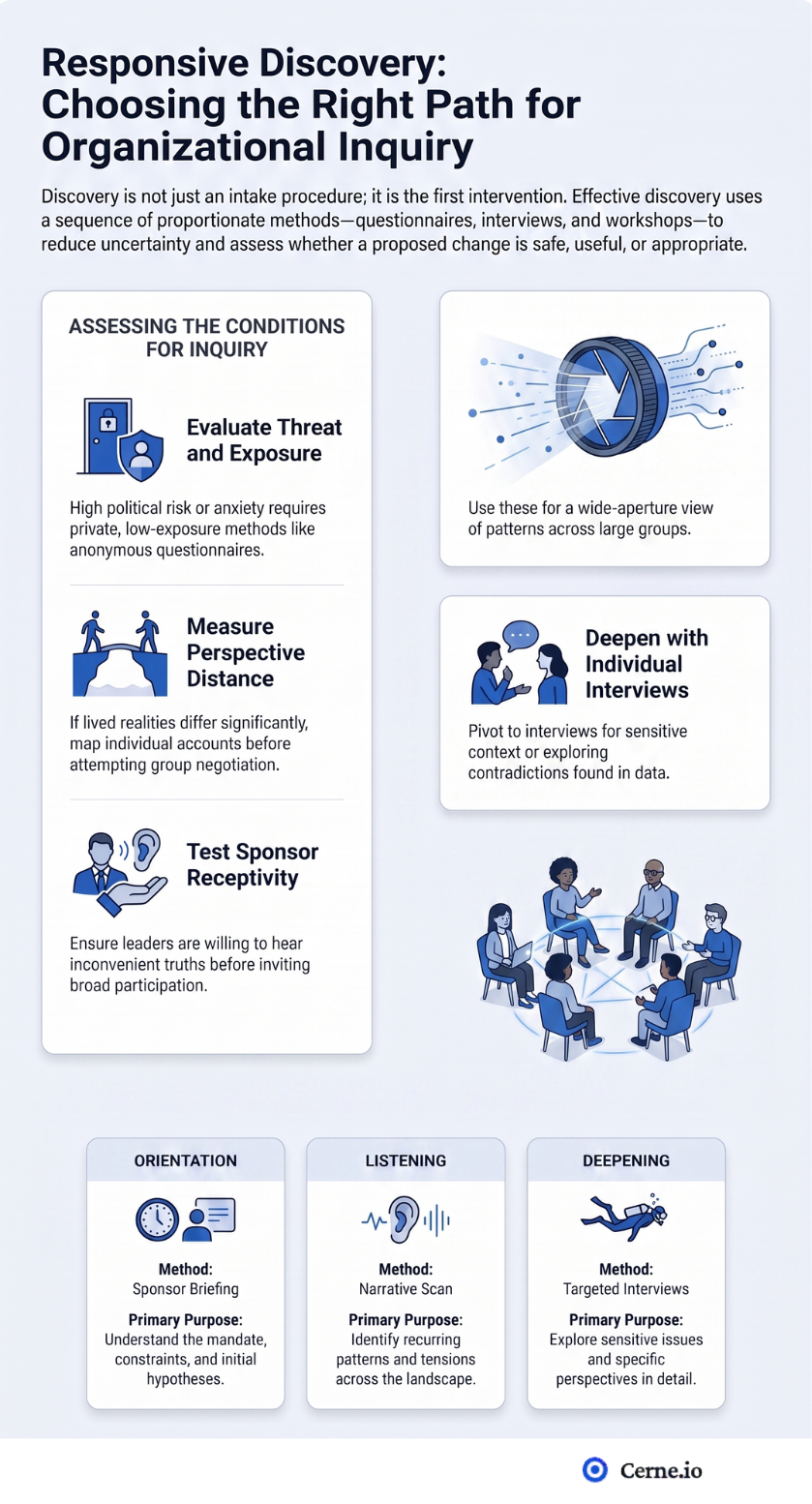
When the path is not known in advance, the first task is not to diagnose the entire organization. It is to learn about the current conditions for inquiry.
A sponsor briefing, document review, or light narrative scan can reveal signals that affect what should happen next. These early interactions are not final findings. They are small, deliberate acts of inquiry that help a practitioner assess what kind of listening and conversation is responsible.
Four conditions are especially important.
1. Threat and exposure
How much political risk, anxiety, or reputational exposure surrounds the issue?
If naming ordinary tensions produces defensive language, nervous silence, or quick reassurance from leaders, a mixed-group workshop may generate compliance rather than candor. In that case, begin with lower-exposure methods: a private narrative questionnaire designed to reduce identifiability, confidential interviews, or role-specific conversations.
Psychological safety concerns whether people can speak candidly, take interpersonal risks, and raise concerns without anticipating humiliation or punishment. It is closely connected to learning and cooperation in teams.
The point is not to label a group “unsafe.” It is to avoid asking people to take risks that the process is not prepared to hold.
2. Perspective distance
How far apart are people’s lived realities and interpretations of the situation?
Leadership, middle management, frontline teams, customers, operational staff, and external partners may all encounter a nominally shared issue from very different positions. They may have access to different information, incentives, constraints, and consequences.
If the issue is largely informational—people lack a shared understanding of a process or decision—a structured group conversation may help bridge the gap. But if participants inhabit very different realities, the first need may be to hear and map those accounts before asking people to negotiate a common solution.
A narrative questionnaire can be useful here because it gives people space to describe the situation in their own terms, before the sponsor’s categories or a workshop agenda become the only available frame.
3. Sponsor receptivity
Is the sponsor seeking genuine learning, or validation for a predetermined outcome?
This question needs to be asked early and handled carefully. Sponsors do not need to be neutral; they may have legitimate responsibilities, constraints, and strong views. But participants should not be invited into an open-ended inquiry if the sponsor has no willingness to hear inconvenient information or reconsider the framing.
If leadership is closed to uncomfortable findings, an open-ended workshop risks setting participants up for betrayal. Before inviting broad participation, clarify:
- What decisions are genuinely open.
- What constraints are fixed.
- Who will receive the findings.
- What the sponsor is prepared to reconsider.
- How participants will learn what happened with their input.
Sometimes the responsible next step is a sponsor debrief—not a wider survey or workshop.
4. Systemic capacity
How much energy, attention, and trust does the organization have for another initiative?
Organizations carry memories of prior surveys, change programs, strategy exercises, restructures, and workshops. If people have repeatedly been asked for input without seeing meaningful follow-through, another conventional survey may produce tired, guarded, or cynical responses.
This is not merely “survey fatigue.” It is often an understandable response to the organization’s history of inquiry and follow-through.
A short, human narrative prompt grounded in a concrete moment can be more respectful than a long rating-scale instrument. But brevity alone is not enough. Participants also need to understand why they are being asked, how their input will be used, and what will happen afterward.
What each method can reveal
Questionnaires, interviews, group conversations, documents, and observation are not interchangeable formats for asking roughly the same questions. Each makes different evidence available and creates different conditions for participation.
| Method | Best for learning | Main strengths | Main limitations |
|---|---|---|---|
| Narrative questionnaire | How a wider group describes its experience, concerns, hopes, constraints, and interpretations | Reaches more people; gives time for reflection; can provide a lower-exposure route to contribute; makes variation visible before a meeting | Limited ability to probe in real time; response rates vary; does not reveal live interaction dynamics |
| Individual interview | Context, history, tacit knowledge, sensitive concerns, and the meaning behind a person’s account | Allows follow-up; supports nuance; may offer greater privacy for politically sensitive matters | Time-intensive; reaches fewer people; interviewer framing can shape what is heard |
| Group conversation | Live differences, shared language, interaction patterns, joint sensemaking, and collective work | Participants can respond to one another; can make disagreement visible; supports shared understanding when conditions are right | Power dynamics can silence dissent; dominant voices can steer the discussion; not suitable for raw or uncontained conflict |
| Document review | Formal commitments, prior decisions, role definitions, policies, plans, metrics, and previous attempts | Provides context; identifies the official account; may expose gaps between formal process and everyday practice | Shows what was recorded or intended, not necessarily how work is experienced |
| Observation or process review | What happens in meetings, handoffs, decision processes, or service delivery | Can reveal unwritten routines and operational friction that people no longer notice or describe | Requires access; can feel intrusive; demands careful interpretation because observation itself can affect behavior |
Choose a method for the kind of learning it can produce—not because it is the default tool in your practice.
Begin with narrative listening
A narrative questionnaire is particularly useful near the beginning of discovery when a practitioner needs a wide-aperture, lower-exposure view of the organizational landscape before deciding what deeper inquiry or collective work should follow.
Unlike a conventional employee survey, its primary purpose is not to generate a rating score.
Consider questions such as:
- “How aligned are you, from one to five?”
- “How satisfied are you with communication?”
- “Do you agree that collaboration is improving?”
These can be useful when an organization is monitoring a known condition over time. But they may be poorly suited to early discovery, when the practitioner does not yet know whether “alignment,” “communication,” or “collaboration” are the right categories—or whether people mean the same thing by them.
A narrative questionnaire starts from lived experience. It invites people to describe an episode, situation, observation, or account in their own words, then reflect on what that account means to them.
For example:
Think of a recent moment when working across teams either went especially well or became difficult. What happened?
Follow with prompts such as:
- What made this situation significant?
- What was at stake for you or your work?
- Which conditions helped or hindered progress?
- How typical was this experience?
- What would someone outside your team need to understand about it?
- What question should leaders or facilitators take seriously before deciding what to do next?
Cerne draws inspiration from Participatory Narrative Inquiry (PNI), particularly its commitment to treating people’s stories and interpretations as meaningful evidence—not merely raw material for an outside expert’s conclusion. It supports an early stage of discovery in which stakeholders share accounts of experience and reflect on those accounts through structured prompts, sliders, and triangles. These narratives and reflections give practitioners a broader basis for identifying the questions that deserve deeper conversation.
↓
Participant self-interpretation
↓
Patterns and tensions
↓
Working hypotheses
↓
Next conversation
Rather than beginning with, “Here is the problem we need to validate,” the process begins with, “What is happening from where you stand?”
Let the inquiry branch
A narrative questionnaire broadens the field of view, but it should rarely stand alone.
For example, several people may describe decision bottlenecks. That pattern may be important, but it does not by itself establish whether the bottlenecks arise from unclear authority, informal power, incompatible goals, limited capacity, insufficient information, or fear of making difficult trade-offs.
Likewise, several people may refer to “poor communication,” while describing very different realities:
- One team does not receive decisions early enough to act.
- Another feels excluded from decisions that affect its work.
- A leader sees a problem of message consistency.
- Frontline staff need a safer way to challenge assumptions.
- A sponsor interprets all of this as a need for “alignment.”
The purpose of early narrative listening is not to settle the explanation. It is to reveal which explanations need to be explored.
The discovery path should then adapt.
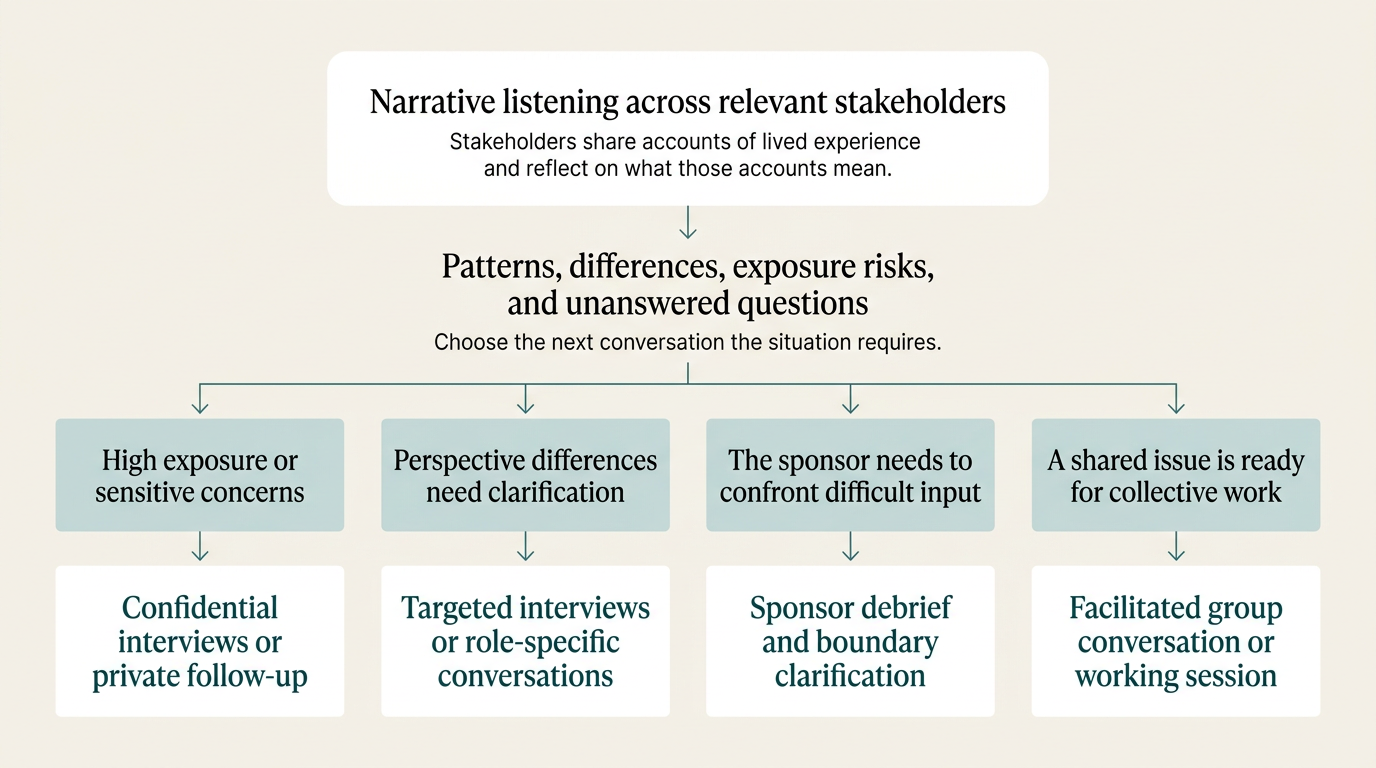
If early accounts reveal political fear or taboo topics, pivot toward confidential interviews or private follow-up. The aim is to deepen context and clarify boundaries before asking people to speak publicly.
If early accounts reveal a relatively clear operational challenge between willing teams, a cross-functional working session may be appropriate. Participants can use the session to compare experiences, build shared language, and design practical improvements.
If early accounts reveal a pronounced gap between executive rhetoric and daily operational reality, begin with a sponsor readout. Test whether leadership is willing to confront the gap before exposing participants to a process that may not lead anywhere.
This is what makes discovery responsive. The initial method does not mechanically determine the next one; it informs professional judgment about the next most responsible move.
Use mixed methods sequentially
Consultants often use multiple methods. But running several activities in parallel without feedback loops does not automatically produce a coherent discovery process.
The value of mixed methods comes from integration: allowing the evidence from one stage to shape the design of the next.
Mixed-method research combines qualitative and quantitative approaches so that different forms of evidence can answer different aspects of a complex question. Methodological triangulation more broadly involves examining a phenomenon through multiple methods, sources, perspectives, or investigators.
For consulting discovery, the practical question is:
What can this method help us see that the previous method could not?
A sequential discovery process may look like this:
| Stage | Method | Purpose | Output |
|---|---|---|---|
| 1. Initial orientation | Sponsor conversation and document review | Understand the mandate, constraints, history, formal commitments, and initial hypotheses | A provisional inquiry plan |
| 2. Broad listening | Narrative questionnaire | Hear lived experience, participant self-interpretation, and early tensions before the group process is designed | A map of recurring patterns, differences, exceptions, and open questions |
| 3. Deepening | Selected interviews | Explore sensitive issues, distinctive perspectives, historical context, or contradictions surfaced in the narrative input | Better-grounded working hypotheses and refined questions |
| 4. Collective sensemaking | Group conversation or workshop | Surface differences, develop shared language, examine tensions, and work on what requires collective action | A jointly developed view of what needs attention |
| 5. Readout and response | Sponsor debrief and participant follow-up | Distinguish what was heard from interpretation and recommendation; show how input informed the decision | A defensible next step and a closed feedback loop |
If you send a survey, schedule twenty interviews, and book a two-day workshop before reviewing any incoming input, you are executing a package rather than conducting discovery.
A responsive approach allows early accounts to change:
- Whom you speak to next.
- What you need to ask.
- Whether a group conversation is safe.
- Which groups should or should not be brought together yet.
- Whether the original workshop request still makes sense.
- What meaningful follow-through would require.
Triangulation is not a vote
Triangulation is often misunderstood as a technique for proving that something is true because several sources say the same thing.
Agreement can increase confidence in a pattern. If narrative responses, interview accounts, and workflow documents all point to the same handoff failure, that convergence is meaningful.
But agreement is only one useful outcome.
Different methods may reveal different accounts because people occupy different structural positions:
- Leaders describe a strategic priority.
- Managers describe ambiguous trade-offs.
- Frontline staff describe tooling, workload, or customer-impact constraints.
- External partners describe the friction created by internal handoffs they do not see.
These accounts may conflict, yet each may describe something real from its particular position in the system.
Triangulation should not flatten differences into the most common denominator. It should help the practitioner understand what each form of evidence adds.
| Result | What it may mean | What to do next |
|---|---|---|
| Convergence | Different sources point toward a similar pattern | Increase confidence while continuing to examine scope, exceptions, and consequences |
| Complementarity | Different methods reveal compatible but distinct aspects of the situation | Combine the accounts into a fuller understanding rather than privileging one source |
| Divergence | Sources or stakeholder groups offer genuinely different accounts | Investigate what conditions produce the difference rather than averaging it away |
| Silence or absence | A perspective, issue, or group has not appeared in the inquiry | Ask whether access, framing, trust, power, or method choice has limited what could be heard |
Mixed-method inquiry can generate convergent, complementary, or divergent findings. Divergence is not automatically a failure; it may identify a meaningful difference that needs further exploration.
The point is to understand:
- What recurs across sources.
- Where accounts diverge.
- Which differences are tied to role, authority, proximity, incentives, or lived experience.
- Which apparent contradictions require deeper inquiry.
- What the intervention must accommodate if it is to remain credible.
When to use each method
Use a narrative questionnaire when
- You need a broad initial scan across a group too large for individual interviews.
- You want to hear people’s own framing before a workshop agenda is fixed.
- Participants need private time to reflect.
- You want to identify whose experiences differ before selecting interviewees.
- The immediate decision concerns scope, participation, risk, or intervention design.
- You need a structured record of what people said and how they interpreted their experience.
Use interviews when
- The issue is sensitive, politically charged, emotionally difficult, or unsafe to discuss in a group.
- You need history, context, examples, or clarification that a questionnaire cannot provide.
- You need to understand strategically important, underrepresented, or otherwise missing perspectives.
- Early narrative accounts reveal contradictions that deserve patient exploration.
- Silence, brevity, or unusually careful language may signal an issue that cannot yet be discussed openly.
Use a group conversation when
- Participants need to hear how others experience the situation.
- The issue requires shared interpretation, coordination, negotiation, or joint decision-making.
- The group has enough safety and facilitation support to discuss differences productively.
- You want to observe how assumptions, ideas, and disagreement develop through interaction.
- A useful next step requires shared language and collective work rather than private individual input.
Do not begin with a group conversation when
- Participants reasonably fear retaliation, reputational damage, or exclusion.
- Status differences make candid participation unlikely.
- The sponsor expects consensus before differences have been mapped.
- Participants have not had a private way to describe concerns.
- The issue is too ambiguous to frame a productive shared conversation.
- There is no credible path from conversation to action.
Cerne’s two-part discovery process
Cerne supports two connected forms of listening: distributed narrative listening and purposeful follow-up conversation.
Distributed narrative listening
Before setting an agenda or convening a gathering, the practitioner invites relevant stakeholders to share accounts of lived experience: moments of friction, examples of progress, practical constraints, unresolved concerns, and hopes for what could change.
Participants can also interpret their stories through structured prompts.
This stage helps map the organizational landscape:
- What patterns keep recurring?
- Where do groups describe reality differently?
- Which concerns are common but differently explained?
- Which perspectives appear absent?
- What tensions need attention before people are convened?
- What question should shape the next conversation?
The aim is not to automatically extract a final diagnosis. It is to make participants’ accounts and interpretations visible, so practitioners can generate more grounded working hypotheses.
Purposeful follow-up conversation
The patterns, tensions, exceptions, and unanswered questions in the narrative input inform what happens next:
- Confidential interviews.
- Role-specific conversations.
- A sponsor debrief.
- A leadership discussion.
- A cross-functional workshop.
- A decision that a workshop is not yet the right intervention.
The next conversation begins from a broader and more structured record of the present situation—not solely from the sponsor’s brief, a generic workshop agenda, or the most confident voices in the room.
| Cerne stage | Practitioner task | Value |
|---|---|---|
| Narrative survey | Invite stakeholders to share and self-interpret lived experience through prompts, sliders, and triangles | Broadens the field of view before assumptions harden into an agenda |
| Pattern review | Identify recurring narratives, differences, polarities, blind spots, and unanswered questions | Generates grounded working hypotheses without mistaking them for final conclusions |
| Follow-up conversations | Use interviews or group sessions to explore, complicate, test, and respond to what emerged | Produces richer context and prepares people for more useful joint sensemaking |
| Discovery readout | Distinguish evidence, participant interpretation, practitioner interpretation, uncertainty, and recommended next steps | Gives sponsors a transparent and defensible basis for action |
Cerne does not replace interviews or facilitation. It helps practitioners enter those conversations with a broader record of experience—one that includes perspectives beyond the sponsor brief and beyond the people most likely to dominate a live discussion.
A note on limits
No method eliminates interpretation, and no combination of methods guarantees certainty. A large response set is not an automatic mandate. A small number of interviews does not establish causality. A workshop cannot resolve structural problems that leaders are unwilling or unable to address.
Be precise about what discovery can legitimately claim.
Prefer language such as:
- “A recurring pattern in the narrative responses was…”
- “Accounts differed most sharply between frontline teams and regional leads…”
- “Interviews suggest that this friction may relate to unclear decision rights…”
- “The current inquiry does not establish whether this is primarily an operational or structural bottleneck…”
- “This concern did not appear consistently across groups and needs further exploration…”
- “The next session should address this tension directly rather than assume alignment.”
Also be precise about confidentiality. Do not promise anonymity where a small team, distinctive role, or specific incident could make a participant identifiable. Explain what will be shared, who will see it, how attribution will be handled, and the limits of confidentiality before inviting people to contribute.
That restraint is not a weakness in the method. It is what makes discovery trustworthy.
The practical takeaway
Choose a narrative questionnaire when you need breadth, private reflection, and an initial view of how people experience the situation. Choose interviews when you need depth, context, confidentiality, or careful follow-up. Choose group conversations when people need to make sense of an issue together and the conditions exist for meaningful participation.
Use mixed methods when each step contributes something distinct and the early evidence can genuinely reshape what happens next.
↓
Narrative patterns and conditions for participation
↓
Targeted deepening
↓
Collective sensemaking, if appropriate
↓
More responsible intervention design
The goal is not to amass data or execute a polished, off-the-shelf process. It is to listen from enough relevant positions, with enough care, to design the next conversation the situation actually requires.
Start with data, not assumptions.
Cerne helps facilitators and consultants gather stakeholder narratives, make patterns and differences visible, and design the next conversation with greater care.